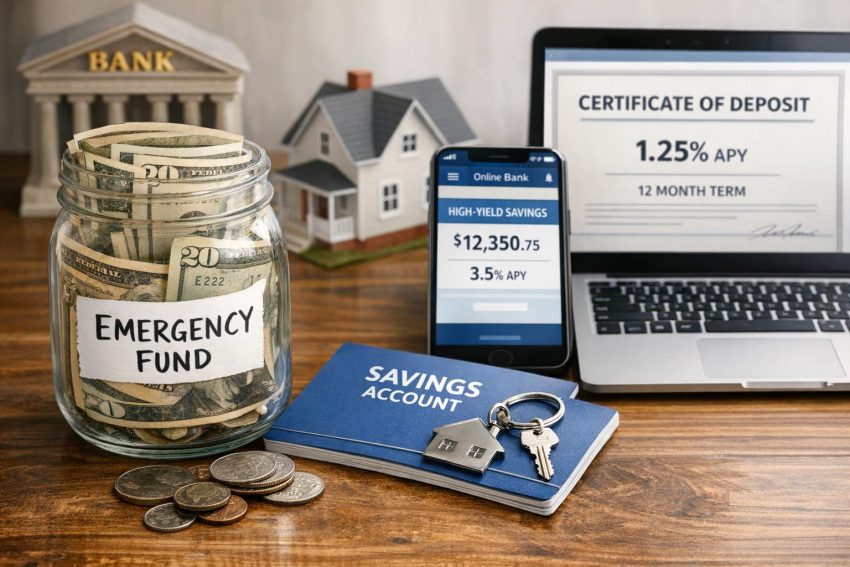
Emergency savings should be kept somewhere that protects the principal, permits reasonably fast access, and separates the money from routine household spending. Its main purpose is not to produce the highest available return. The fund exists to pay necessary costs after an income interruption or an unexpected bill, such as medical treatment, urgent home repairs, vehicle repairs, insurance deductibles, or a period without work.
The right place depends on the amount saved, how quickly the money may be needed, the banking services available in the saver’s country, and the level of financial risk the household can accept. For most people, an insured deposit account is a better home for emergency money than shares, funds, or other investments whose market value can change.
A good account combines principal protection, dependable access, modest interest, reasonable fees, and terms that are easy to verify. No single account will lead every category. A bank offering a high rate may take several days to process an external transfer, while a local institution may pay less but provide branch access and same-bank transfers. The practical choice often involves dividing the fund between two locations.
What Emergency Savings Need to Do
An emergency fund has a different purpose from retirement investments, ordinary spending money, or savings for a planned purchase. Long-term investments can remain invested through market declines because the investor may not need the money for years. Emergency savings may be required tomorrow morning. Preserving the balance and obtaining access matter more than maximizing growth.
Four account qualities deserve attention:
- Principal protection: The account should carry a low chance of losing money.
- Liquidity: Withdrawals or transfers should be available within a practical period and without a large penalty.
- Separation: The fund should sit apart from daily spending money so it does not gradually disappear on groceries, subscriptions, and routine purchases.
- Reliability: The account provider, login process, transfer network, and customer service should work when the money is needed.
Interest still matters because inflation reduces what cash can buy over time. If prices rise while an account pays almost nothing, the fund loses purchasing power. Even so, a modest improvement in interest rarely justifies market risk, long withdrawal delays, or an early redemption penalty on the full balance.
Emergency money also needs a clear definition. A planned holiday, annual insurance premium, or known property tax bill is not an emergency. Those costs belong in separate savings categories, often called sinking funds. Keeping planned expenses apart prevents a predictable bill from draining money reserved for job loss or urgent repairs.
Comparing the Main Places to Keep an Emergency Fund
| Account or asset | Access | Principal risk | Interest potential | Usual role |
|---|---|---|---|---|
| High-yield savings account | Usually same day to several business days | Low when eligible for deposit protection | Moderate for cash | Main emergency reserve |
| Traditional savings account | Often immediate within the same bank | Low when protected | Usually low to moderate | Immediate or branch-access reserve |
| Money market deposit account | Usually prompt, subject to account rules | Low when protected | Moderate | Main reserve or secondary cash layer |
| Money market mutual fund | Often one or more settlement days | Low, but not zero | Moderate | Secondary reserve for experienced investors |
| Short-term fixed deposit | Restricted until maturity or subject to penalty | Low when protected | Predictable | Later cash layer |
| Separate checking or current account | Immediate | Low when protected | Low | First line of access |
| Cash at home | Immediate | Risk of theft, loss, or damage | None | Short disruption reserve |
| Stocks or stock funds | Sale and settlement required | High over short periods | Higher long-term potential | Usually unsuitable |
The table shows why a savings account is often the default choice. It does not promise the best return, but it performs the job with fewer complications. The rest of the decision comes down to access times, insurance coverage, fees, and personal spending habits.
High-Yield Savings Accounts
A high-yield savings account is one of the most practical places to hold an emergency fund. It normally pays more than a basic savings or checking account while allowing withdrawals when required. Traditional banks, online banks, credit unions, building societies, and other regulated deposit institutions may offer these accounts.
The main benefit is the balance between access and interest. Money remains in cash rather than being exposed to market price changes. Many providers allow electronic transfers to a linked checking or current account. Some offer direct bill payments, cash cards, or instant transfers, though easier spending access is not always desirable.
The label high yield has no fixed legal meaning in many countries. It is a marketing description, not a promise that the rate will remain near the top of the market. A provider can reduce a variable rate after the account opens. Savers should compare the standard ongoing rate rather than relying on the account name.
Check whether the institution participates in the applicable deposit protection program. In the United States, eligible deposits at covered banks may receive Federal Deposit Insurance Corporation protection within applicable ownership and coverage limits. Federally insured credit unions generally use a separate program. The United Kingdom, Canada, Australia, European countries, and other jurisdictions apply their own rules, account categories, and payment limits.
Deposit protection normally applies if a covered institution fails. It does not act as general protection against every loss. Unauthorized transfers, identity theft, payments sent to scammers, and losses in investment products may fall under different rules. The legal name of the deposit-taking institution matters because financial brands sometimes share a parent bank or place customer deposits with a partner bank.
How to Compare High-Yield Accounts
Start with the interest measure used in the relevant country. Banks may quote annual percentage yield, annual equivalent rate, or a nominal annual rate. These measures do not always work in exactly the same manner. The account disclosure should state how interest is calculated, when it compounds, and how often the bank credits it.
Next, review access. Find out how long an outbound transfer normally takes and whether faster payment methods are available. Some providers impose daily or monthly transfer caps. A transfer limit that looks generous during account opening may become a problem when a large home repair bill arrives.
Monthly charges, minimum balances, inactivity fees, paper statement fees, and transfer charges can erase part of the interest. A slightly lower rate with no maintenance charge may leave the saver with more money at year-end. This is particularly true during the early months of building a fund, when the balance is still small.
Promotional rates need care. A bonus may apply only for several months, only to new deposits, or only when the customer meets deposit and transaction conditions. There is nothing inherently wrong with a promotional rate, but the ordinary rate should still be acceptable once the offer ends.
Online Savings Accounts
Online savings accounts often pay attractive rates because their providers operate fewer branches and may have lower premises costs. They suit people who are comfortable managing transfers, statements, identity checks, and support requests through an application or website.
The primary concern is access speed. Transfers between banks can take one or more business days, especially around weekends and public holidays. Some banks use instant payment networks, while others process transfers in batches. An account that pays well but takes three days to release money may work for the larger part of a fund, provided another account holds enough for immediate costs.
Before depositing money, confirm the provider’s legal identity and regulatory status. A banking application can have a polished interface without being a bank. Some financial technology firms place customer money at partner institutions. That arrangement may still receive deposit protection, but the account documents should explain who holds the deposit and how coverage is applied.
Customer support also matters. Check opening hours, telephone access, live chat arrangements, and procedures for a locked account. An online provider that communicates only through an application can be awkward if the customer loses the phone used for authentication. Recovery methods should be set up before the account contains a large balance.
A practical test is to make a small deposit, transfer part of it back, and note the timing. This confirms that linked accounts, account numbers, and authentication steps work. It is better to find a transfer problem during a routine test than while a contractor is waiting for payment.
Traditional Bank and Credit Union Savings Accounts
A savings account at a local bank, building society, or credit union may pay less than an online account, but it can offer useful access. Customers may visit a branch, deposit cash, request a bank check, or discuss an account problem face to face. People who receive part of their income in cash may find this far more practical than mailing deposits or using an indirect cash service.
Keeping savings at the same institution as the household checking account can make internal transfers almost immediate. That convenience is valuable when an urgent payment cannot wait until the next business day. It can also simplify account management because the customer has one login and one support number.
There is a behavioural cost, however. If savings appear beside the spending balance whenever the banking application opens, the money may feel readily available for non-emergency purchases. Some people manage this well. Others benefit from placing the fund at a separate institution where it is out of everyday view.
Compare the annual interest difference in money terms rather than percentages alone. Suppose one account pays one percentage point more than another. On a balance of $2,000, the gross difference is about $20 a year before tax and rate changes. Avoiding a monthly fee or gaining immediate branch access may be worth more than that difference.
Money Market Deposit Accounts
A money market deposit account is a deposit product offered by a bank or credit union. It may pay a variable rate and may include check-writing or debit card access. Account structures vary, so the name alone reveals little about fees, withdrawal rules, or interest.
When eligible for deposit insurance, this type of account can receive protection similar to other covered deposits. It may pay more than a basic savings account, particularly for larger balances. Some providers use balance tiers, meaning the rate changes after the account reaches a stated amount.
Minimum balance rules deserve close attention. An account may advertise a strong rate but charge a fee whenever the balance falls below a threshold. An emergency withdrawal could therefore trigger a fee at exactly the wrong time. Other accounts reduce the rate rather than charging directly.
Check-writing and card access can be helpful for prompt payments, but they also make the reserve easier to spend. A saver who tends to dip into savings may prefer an account without a payment card. A small amount of friction is often useful, provided it does not prevent access during a genuine emergency.
Money Market Mutual Funds
A money market mutual fund invests in short-term debt instruments, which may include government securities, bank obligations, and high-quality corporate debt. Fund managers generally aim to maintain a stable value and provide ready access to cash. Even so, the fund is an investment rather than a bank deposit.
This distinction affects both risk and legal protection. A money market fund generally does not receive bank deposit insurance. Its value can fall, even if such events are uncommon for conservatively managed funds. Fees, settlement periods, brokerage procedures, and temporary redemption controls may also affect access.
Government money market funds may hold mainly short-term government instruments, while prime funds may hold more corporate obligations. Tax-exempt funds can hold short-term municipal debt in countries where such products exist. These categories can carry different yields, tax treatment, and credit exposure.
A money market fund may suit an experienced investor who already uses a brokerage account and understands settlement procedures. It is less convincing as the only home for emergency savings. A deposit account is generally simpler for paying rent, utilities, medical providers, or repair bills at short notice.
Brokerage Cash Is Not Always Bank Cash
Cash shown in a brokerage account can be held in several forms. It may remain as an uninvested brokerage balance, move automatically into a partner-bank sweep program, or be invested in a money market mutual fund. Each arrangement has different protection and withdrawal rules.
A bank sweep can place money with one or more participating banks and may qualify for deposit insurance within program limits. A money market fund is normally covered by securities rules rather than deposit insurance. Securities protection may address missing customer assets if a broker fails, but it does not reimburse ordinary investment losses.
Brokerage withdrawals may also require the sale of a fund followed by settlement and a bank transfer. Weekend requests can take longer. Anyone keeping part of an emergency fund at a broker should know the cash position, settlement schedule, transfer cap, and destination bank before relying on the account.
Short-Term Certificates of Deposit and Fixed-Term Accounts
A certificate of deposit, term deposit, or fixed-rate savings bond pays a stated rate in exchange for leaving money deposited for an agreed period. Terms can run from a few weeks to several years. If issued by an eligible deposit institution, the account may receive the same type of deposit protection as ordinary savings, subject to local rules.
The trade-off is reduced liquidity. Early withdrawal may trigger a loss of interest, a fixed charge, a notice period, or a refusal to release the funds before maturity. Some banks allow hardship withdrawals, but the conditions differ and should not be assumed.
Because of these restrictions, a fixed-term account rarely suits the entire fund. It may hold a later layer of cash after the household has built enough immediate savings. A person with six months of expenses saved might keep the first few months in accessible accounts and place part of the remaining balance in short terms.
Using a Deposit Ladder
A deposit ladder divides money among several accounts with different maturity dates. Rather than placing $12,000 into one annual deposit, a saver could divide it among deposits that mature at intervals. As each one matures, the money can be spent, moved to savings, or placed into a new term.
This approach creates recurring access and can lock in rates for part of the balance. It also brings administrative work. Maturity dates need monitoring, automatic renewal settings must be checked, and early withdrawal terms still apply between maturities.
A ladder is better suited to a mature emergency reserve than a newly started one. A household with only a few weeks of expenses saved should generally favour access. The extra interest from a term account will not compensate for having to borrow at a high rate because cash is locked away.
Separate Checking or Current Accounts
A separate checking or current account can hold the portion needed immediately. It may pay little or no interest, but it supports debit card payments, cash withdrawals, bank transfers, and direct bill payments. That speed can matter after a vehicle breakdown, urgent dental treatment, or a temporary problem with the household’s main bank.
The account should remain separate from ordinary spending. Mixing emergency funds with grocery money makes the available balance hard to interpret. A household may believe it has $4,000 available, even though $3,000 is meant for emergencies and upcoming bills will use the rest.
Some savers keep this account at their main bank for instant internal transfers. Others use a second institution to reduce temptation and provide backup if the main bank experiences an outage or freezes an account. Both arrangements can work. The better choice depends on spending habits and the speed of external transfers.
Overdraft settings warrant attention. An emergency account should not routinely cover overspending in another account through automatic overdraft transfers. That feature can drain the reserve without a deliberate decision. Disabling it, or setting account alerts, provides better control.
Physical Cash Kept at Home
A modest amount of physical cash can help during a power cut, natural disaster, payment network outage, bank system failure, or evacuation. Card terminals and cash machines do not always work during local disruptions. Cash can pay for food, fuel, transport, medication, and basic supplies until electronic payments return.
Physical money has clear weaknesses. It earns no interest and can be stolen, misplaced, damaged by fire, or destroyed by water. Home and renters insurance policies often place low reimbursement caps on cash. Documentation may also be difficult after a loss.
For those reasons, home cash should act as a supplementary reserve rather than the main fund. The amount can reflect several days of normal necessary spending. Small denominations are helpful because retailers may not have change during an outage.
Storage should be discreet, dry, and reasonably secure. Household members who may need the cash should know how to reach it, but casual visitors should not. Large sums create more risk than convenience and usually belong in a protected financial institution.
Government Bills and Other Short-Term Securities
Short-term government bills are debt securities that mature after a relatively brief period. They are often viewed as low-credit-risk assets when issued by financially stable national governments. Investors may purchase them through a broker, bank, or government platform, depending on the country.
These securities can pay a competitive return, but they are not as simple as a savings account. Money may be inaccessible until maturity unless the bill can be sold. A sale before maturity may produce a different price, and brokerage settlement or transfer times can delay access.
Directly held bills with short maturities may have a place in a large, established reserve. They are less suitable for the first layer of emergency cash. Treasury or government bond funds are different from holding a bill to maturity because fund prices move as interest rates and market conditions change.
Tax treatment can affect the return. Interest on some government securities receives favourable treatment at certain tax levels, while other countries provide no such benefit. Tax rules can change, so the after-tax return should be compared with a deposit account rather than relying on the headline yield.
Why Stocks and Other Market Investments Usually Do Not Fit
Stocks, exchange-traded funds, property funds, commodities, and similar investments can produce stronger returns over long periods. They can also fall sharply with little warning. An emergency may arrive during a market decline, forcing the owner to sell at a loss.
This is a timing problem. Job losses and business slowdowns can occur during the same periods as falling markets. A household could face reduced income just as its investment-based emergency fund loses value. Selling then converts a temporary market decline into a permanent loss.
Bonds are not automatically safe for short-term cash needs. Bond prices usually react to interest-rate movements, and longer maturities tend to move more. Corporate bonds carry issuer credit risk. Bond funds have no fixed maturity for each investor and can show losses when rates rise.
Cryptoassets are even less appropriate for emergency reserves. Prices can move sharply, trading platforms can restrict withdrawals, and legal protections differ from those applied to bank deposits. A payment that must be made in national currency should not depend on selling a volatile asset at an acceptable price.
Investing can begin alongside emergency saving, particularly where an employer offers valuable retirement contributions. Still, money intended to cover near-term living costs should usually remain in cash or another low-risk, accessible form.
Why Retirement Accounts Are Poor Emergency Accounts
Retirement accounts are intended for long-term saving and may receive tax advantages. Withdrawals before the permitted age can trigger income tax, penalties, administrative delays, or loss of future tax-sheltered growth. Rules vary by account type and country.
Some retirement plans permit loans or hardship withdrawals. Access does not make the account a good emergency fund. A plan loan may become due after leaving an employer, while a hardship withdrawal can permanently reduce the amount available in later life.
Severe circumstances sometimes leave no other choice. Even then, having a separate cash reserve can reduce the amount withdrawn and preserve more retirement money. Building a starter emergency fund before increasing voluntary long-term contributions is often a practical compromise, subject to any employer matching benefit.
How Much Should Stay in Immediate Access?
Not every part of an emergency fund must be available within minutes. A layered arrangement can provide fast access while allowing the larger balance to earn a better rate.
The first layer might cover several days or a few weeks of necessary costs. It can sit in a separate checking account, same-bank savings account, or a combination of bank funds and modest home cash. The next layer can remain in a high-yield savings account that may require an external transfer. A later layer may use short fixed terms or conservative cash instruments.
The right split depends on household circumstances. Variable income, self-employment, a single wage earner, recurring medical needs, an older vehicle, or an ageing property can justify more readily accessible cash. A household with two stable incomes, low fixed costs, and reliable insurance may accept a longer transfer period for part of the reserve.
Credit cards can bridge a brief transfer delay, but they should not replace savings. Available credit can be reduced or cancelled, and a card balance becomes expensive if the bank transfer does not arrive before interest begins. The fund should be capable of paying the card promptly rather than relying on long-term borrowing.
Access Should Be Tested Before It Is Needed
An emergency account is useful only if the owner can reach it. Log in periodically, confirm contact details, and verify that linked accounts remain active. Banks may close inactive connections or request a fresh identity check after long periods without transactions.
Authentication deserves planning. A lost phone, changed telephone number, expired identification document, or forgotten password can delay a withdrawal. Store recovery codes securely where offered, and make sure a trusted joint owner knows how the account works if the fund supports a household.
Test transfers with a small amount. Note cutoff times, weekend processing, withdrawal caps, and any hold placed on newly deposited money. Some banks let customers raise a transfer limit after extra verification, but that process may take time.
Joint households should discuss who can authorize withdrawals. An account held in one person’s name may become difficult for the other person to access during illness or incapacity. Joint ownership, account mandates, or legal authority may help, though each choice has legal and tax effects.
Interest Rates, Inflation, and Taxes
Variable savings rates move over time. A bank that leads the market one month may reduce its rate later. Checking the account a few times a year is usually enough; moving money every time another bank offers a tiny increase can create paperwork and access problems without adding much income.
Calculate the expected interest in currency terms. A rate difference of 0.25 percentage points produces about $25 a year on $10,000 before compounding and tax. That may justify a simple account switch, but perhaps not one involving poor service, slow transfers, or unclear protection.
Inflation matters because emergency costs rise with prices. Interest can offset part of that effect, though cash rates may not always keep pace. The answer is not to expose the reserve to large market losses. Instead, review the target balance as rent, food, insurance, transport, and medical costs change.
Interest may be taxable. Some countries provide tax-free allowances or special savings accounts, while others tax nearly all deposit interest. Compare returns after fees and expected tax. Tax treatment should remain secondary to safety and access, but it can affect the choice between accounts with similar terms.
Fees and Account Rules That Can Reduce the Fund
Maintenance charges can slowly erode an emergency balance. Other possible costs include outbound transfer fees, wire charges, cash withdrawal fees, statement fees, dormant account charges, and penalties for falling below a minimum balance.
Read the fee schedule rather than relying on the main product page. Advertising tends to display the interest rate prominently while placing conditions in smaller text. Check whether the fee waiver depends on monthly deposits, salary payments, card use, or maintaining another account.
Withdrawal restrictions also matter. Some institutions limit the number of transfers during a statement period or reserve the right to require notice. Regulatory withdrawal limits have changed in several countries over time, but banks may retain their own account rules.
Pay attention to deposit holds. A bank may show recently transferred money in the account balance before making it available for withdrawal. This distinction between current balance and available balance can matter after moving a large sum.
Protecting Emergency Savings From Fraud
Security is part of access. A fund lost through account takeover is not available for an emergency. Use a strong password that is not reused on email, shopping, or social media accounts. Enable multifactor authentication and transaction alerts where the institution supports them.
Email security deserves equal care because password reset messages often go to the customer’s email account. Protect that account with its own strong password and authentication method. Review recovery addresses and telephone numbers from time to time.
Be cautious with calls or messages claiming that money must be moved urgently to a safe account. Banks do not normally ask customers to disclose passwords or one-time authentication codes to a caller. End the call and contact the institution using a number from an official statement, bank card, or verified application.
Alerts can report withdrawals, new payees, failed login attempts, profile changes, and low balances. Fast detection may improve the chance of stopping a transfer. Keep devices updated and avoid banking through public computers or unsecured wireless networks.
Deposit Insurance Limits and Multiple Institutions
Deposit protection programs apply maximum coverage amounts. Coverage may be calculated per depositor, per institution, per ownership category, or through another legal method. Several brands can operate under one banking licence, so spreading money across brand names does not always increase protection.
Households with balances above the protected amount can consider using more than one eligible institution. Ownership structures such as individual, joint, trust, or retirement accounts may receive different treatment, depending on local law. Large balances warrant direct confirmation from the protection authority or the institution.
Remember that accrued interest may count toward the insured balance. Leaving a deposit exactly at the coverage ceiling can cause part of it to exceed the cap as interest accumulates. A small margin can prevent this problem.
Most ordinary emergency funds remain below national insurance limits, but people holding proceeds from a home sale, insurance payment, inheritance, or business transaction may temporarily exceed them. Some jurisdictions offer temporary higher protection for qualifying life events, subject to conditions and time periods.
Separating Emergency Money From Planned Expenses
A clear account structure prevents confusion. Emergency savings should not routinely pay annual bills, holidays, gifts, home renovations, or a planned vehicle purchase. Those expenses may be costly, but they are foreseeable.
Separate savings categories can exist within one bank if the provider offers named subaccounts or savings pots. Otherwise, several accounts may work. Too many accounts become tedious, so a simple structure is often enough: daily spending, planned expenses, and emergency savings.
Define withdrawal rules before a stressful event occurs. A genuine emergency is generally necessary, urgent, and unplanned. A broken heating system in winter may qualify. Replacing a working television because a newer model is on sale does not.
After using the fund, rebuilding it becomes a budget priority. The account does not need to return to its former balance immediately, but regular automatic deposits can restore it without relying on repeated manual decisions.
Choosing a Practical Account Arrangement
For many households, a separate insured savings account with a competitive rate and dependable electronic access will hold most emergency money. A smaller amount can remain in a checking or current account for immediate payments, with modest physical cash available for short disruptions.
People with larger reserves may place a later portion in short fixed deposits, government bills, or a brokerage cash product after confirming the risks and access times. The first layer should remain straightforward. Rent, food, utilities, transport, and medical bills do not wait patiently for securities settlement.
The account with the highest advertised yield is not automatically the best choice. Reliable access, deposit protection, low fees, clear ownership, usable customer service, and sensible transfer limits often matter more than a small rate advantage.
Review the arrangement after a job change, move, birth, separation, new loan, major medical diagnosis, or change in household expenses. Bank rates and account terms also change. A brief review two or three times a year can confirm that the balance remains protected, accessible, and separate from routine spending.
The best location is therefore less about finding one perfect product and more about matching the account to the fund’s purpose. Emergency savings should be boring, dependable, and ready to use. For money set aside to handle unwelcome surprises, boring is usually a very good result.