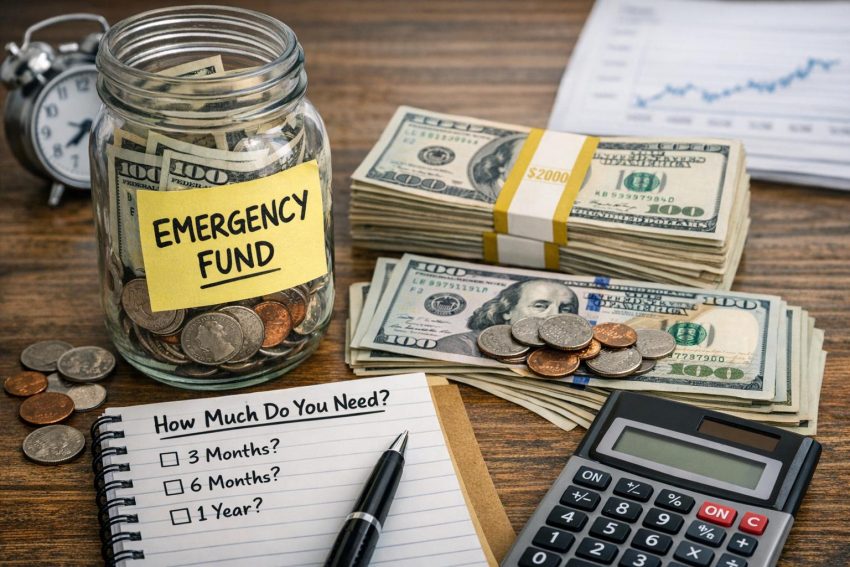
An emergency fund is cash reserved for an unexpected expense or a temporary loss of income. It sits apart from money used for routine bills, planned purchases, investing, retirement, or other long-term goals. Its job is practical: cover necessary costs without forcing a household to rely on high-interest credit, miss payments, or sell investments during a market decline.
There is no single emergency-fund balance that works for every household. The right amount depends on monthly expenses, employment stability, debt payments, insurance coverage, health needs, property ownership, and the number of people relying on the household income. Access to family support, severance pay, government benefits, or a reliable second income can also affect the calculation.
A common starting point is three to six months of essential expenses. That range is useful, but it is not a universal rule. Someone with secure employment and low fixed costs may need less. A self-employed parent with a mortgage and irregular client payments may need nine months or more. The target should reflect actual financial exposure rather than a round number copied from a personal finance checklist.
What an Emergency Fund Is Designed to Cover
Emergency savings should pay for costs that are both necessary and unexpected. The expense should require prompt action and should not already have a place in the normal household budget. Common examples include unemployment, reduced working hours, urgent medical care, emergency travel, essential vehicle repairs, or a broken heating system during cold weather.
The fund can also bridge a timing gap. A worker may have disability insurance, unemployment benefits, or approved paid leave, yet still wait several weeks before receiving money. Emergency cash covers bills during that waiting period. This role matters because a household can be financially secure on paper while still lacking enough cash to meet next Friday’s mortgage payment.
Routine or foreseeable costs generally belong elsewhere. Annual insurance premiums, property taxes, holiday purchases, school supplies, planned dental work, and scheduled vehicle maintenance are better handled with sinking funds. A sinking fund is money saved gradually for an expense that is expected, even if its exact amount or payment date is not yet known.
Some costs sit in a grey area. A vehicle repair may arrive without warning, but repairs are a normal part of owning an older car. A sensible approach is to maintain a vehicle fund for maintenance and eventual replacement, while retaining emergency cash for urgent failures that exceed the vehicle account.
The same principle applies to home ownership. A roof will not last forever, and appliances eventually fail. Saving for predictable replacement costs reduces pressure on the emergency reserve. The emergency fund remains available for events that cannot reasonably be scheduled, such as storm damage not fully covered by insurance.
A Practical Test for Emergency Expenses
Before using the fund, ask whether the cost is necessary, unexpected, and time-sensitive. Then check whether insurance, a sinking fund, or another account should pay it. If the expense passes those tests, an emergency withdrawal is usually reasonable.
A discounted holiday, upgraded phone, furniture sale, or elective home renovation does not become an emergency because the payment deadline is close. Poor timing is not the same as an unforeseen need. Keeping that distinction clear protects the fund from gradual erosion.
Calculate the Target From Essential Expenses
The most useful calculation begins with essential monthly spending rather than gross income. Income does not show how much cash a household needs to keep functioning. Two households may earn the same salary but have very different mortgage payments, childcare costs, debt obligations, and medical bills.
Essential spending generally includes:
- Rent, mortgage payments, and required housing charges
- Electricity, heating, water, and basic communication services
- Groceries and necessary household supplies
- Transportation required for work, school, or medical care
- Insurance premiums
- Minimum loan and credit-card payments
- Medication, medical treatment, and basic care costs
- Childcare or dependent-care expenses that cannot be paused
- Necessary pet care and prescribed veterinary treatment
Dining out, entertainment, optional subscriptions, holidays, premium services, and nonessential shopping can often be reduced during an income interruption. They do not usually need to be included in the core calculation. Still, cutting every discretionary expense to zero may create an unrealistically strict budget, particularly during a long period of unemployment. A modest allowance for basic personal spending can make the estimate more workable.
The basic formula is:
Monthly essential expenses × chosen number of months = emergency-fund target
Suppose a household spends $3,200 each month on unavoidable bills. A three-month reserve would be $9,600, while six months would require $19,200. If the household also wants enough cash for a $1,500 health insurance deductible, it could set a working target of $20,700.
The deductible does not always need to sit on top of the full monthly reserve. Some households prefer to include it because a medical event and an employment interruption can happen at the same time. Others treat the deductible as part of their health savings. Either method can work if the money remains available when required.
Create a Realistic Emergency Budget
An accurate target depends on a realistic emergency budget. Start with three to six months of bank statements, card statements, and payment records. A single month may hide quarterly bills or unusual spending, while a full year may contain old expenses that no longer apply.
Sort each expense into one of four broad groups: unavoidable monthly costs, discretionary spending, annual bills, and irregular costs. The purpose is not to account for every cup of coffee. It is to identify the amount required to maintain housing, food, transport, insurance, debt payments, and basic care.
Be cautious about assuming that spending can be reduced immediately. A subscription may require notice before cancellation. A leased vehicle cannot be returned without possible fees. Childcare may need to continue while a parent looks for work. Health insurance costs can even rise after job loss if coverage was previously subsidised by an employer.
Seasonal bills deserve attention as well. Heating may cost far more in winter, while electricity can rise during a hot summer. A monthly average can help, but the fund should still be able to cover a costly season if an income interruption begins at an awkward time. Emergencies have poor manners and rarely arrive according to the budget calendar.
Use a Reduced Budget, Not an Unrealistic One
An emergency budget should reflect spending that could reasonably continue for several months. It need not support the household’s usual lifestyle, but it should cover more than bare survival. Unrealistic cuts can cause the target to appear safer than it really is.
Suppose normal household spending is $5,400 per month. After removing holidays, restaurant meals, optional shopping, extra loan payments, and several subscriptions, spending falls to $3,800. That reduced figure may be a sound basis for the emergency target. Cutting it to $2,500 by assuming that insurance, transport, childcare, and all personal spending will vanish would produce a weak estimate.
Why Three to Six Months Is Only a Starting Point
The three-to-six-month rule offers a convenient benchmark, but it cannot account for every risk. The chance of losing income matters, as does the likely time needed to replace it. A worker in a broad occupation with regular hiring may return to work faster than someone in a narrow senior role with fewer vacancies.
Employment terms also matter. A permanent employee with paid sick leave, redundancy protection, and disability cover may face less short-term pressure than a contractor whose income stops as soon as a project ends. The contractor may need more cash even when both people report the same annual income.
Fixed costs are another consideration. Households with large mortgage payments, private school fees, support obligations, or high medical bills have less room to reduce spending. A household with low fixed costs can make budget cuts more easily and may be comfortable with a smaller reserve.
Age and career stage can affect the calculation without dictating it. A younger worker may have fewer obligations but less access to credit and fewer accumulated assets. An older worker may hold more savings but face a longer job search after redundancy. The target should follow the financial facts rather than assumptions about age.
Suggested Emergency-Fund Ranges
The following ranges provide planning references. They are not fixed requirements, and the number of months should always be applied to essential spending rather than normal gross income.
| Household circumstances | Possible cash target |
|---|---|
| Stable employment, low fixed costs, good insurance, no dependants | One to three months of essential expenses |
| Employee household with average fixed costs | Three to six months |
| Single-income household or family with dependants | Six to nine months |
| Freelance, seasonal, commission-based, or self-employed income | Six to twelve months |
| High medical costs or weak insurance coverage | Six to twelve months or more |
| Specialised occupation with a potentially long job search | Nine to twelve months |
A lower target does not necessarily indicate poor planning, and a larger balance is not automatically better. Holding too much cash can slow progress on retirement investing, education savings, home ownership, or debt repayment. The aim is to hold enough accessible money for a credible emergency without treating every possible event as equally likely.
Income Stability and Employment Risk
Income stability often has more influence on the target than salary level. A high earner with irregular commissions can face greater cash-flow risk than a moderate earner with a steady contract and strong employment benefits.
Review how often income changes, how quickly a lost job could be replaced, and whether compensation depends on bonuses or overtime. A worker whose base salary covers all essential expenses may not need to include optional bonuses in the emergency calculation. A household that relies on overtime to pay the mortgage has greater exposure.
Industry concentration deserves attention. Two earners provide useful protection only if at least one income is likely to continue. If both adults work for the same employer or in the same sector, layoffs may affect them together. A dual-income household can therefore carry risks that resemble those of a single-income household.
Location also affects job-replacement time. A profession may have regular vacancies nationally but few openings within commuting distance. Moving for work creates its own costs, including deposits, transport, temporary housing, and possible overlap between two homes.
Self-Employed and Freelance Households
Self-employed workers often need a larger personal reserve because income may arrive late or vary sharply between months. A profitable year does not guarantee smooth cash flow. Clients may delay payment, contracts may end, or illness may prevent billable work.
Personal emergency savings should remain separate from business reserves. The business account may need to cover payroll, taxes, rent, software, insurance, and supplier bills. Using business cash for household costs can create accounting problems and leave the business short when its own payments fall due.
A self-employed person can estimate a target by reviewing the weakest income periods from the past two or three years. If revenue regularly falls during certain months, those dips are seasonal rather than unexpected and should be planned through a business cash reserve. The personal emergency fund is for events beyond that normal cycle.
Single-Income and Dual-Income Households
A single-income household generally benefits from a larger reserve because one employment event can stop all earned income. Six to nine months of essential spending may be reasonable where dependants, a mortgage, or hard-to-replace employment are involved.
For dual-income households, compare essential expenses with each person’s take-home pay. If either income can cover the full emergency budget, the household may be comfortable near the lower end of the range. If both incomes are required, the loss of either job still creates a monthly shortfall.
Consider care responsibilities too. One adult may need to reduce working hours if the other becomes ill. In that case, the household may lose part of both incomes at once. A calculation based only on job-loss risk would miss this possibility.
Build the Fund in Manageable Stages
Saving several months of expenses can take years, especially with high housing costs, childcare, or debt repayments. A staged plan makes the task more manageable and provides some protection early on.
The first target can be a starter buffer of $500, $1,000, or the cost of a common urgent expense. A better personalised figure might be the largest insurance deductible, a typical car repair, or one week of essential spending. This amount will not cover prolonged unemployment, but it can prevent a minor problem from moving straight onto a credit card.
After the starter buffer, aim for one month of essential expenses. One month can cover a delayed paycheck, short illness, temporary reduction in hours, or urgent repair. From there, move toward three months and reassess the household’s risk before continuing to six, nine, or twelve months.
Milestones also help households balance competing goals. A person might build a starter fund, collect the full employer retirement match, repay expensive debt, and then resume emergency saving. The order may change according to interest rates, employer benefits, and income security.
Automate Contributions Without Straining Cash Flow
Regular transfers can make saving more consistent. Scheduling a transfer just after payday reduces the chance that the money will be absorbed by routine spending. The transfer should still leave enough in the current account to avoid overdraft fees or missed payments.
Irregular income may call for a percentage approach rather than a fixed monthly transfer. A freelancer could move a set share of every client payment into tax, business, and personal reserve accounts. Windfalls such as tax refunds, bonuses, gifts, or proceeds from selling unused items can also shorten the saving period.
Automation should not replace periodic review. If the account reaches its target, redirecting the transfer to another goal may be more useful than allowing cash to accumulate without a defined purpose.
Emergency Savings and High-Interest Debt
High-interest debt creates a difficult trade-off. Credit-card interest often costs far more than a savings account earns. Holding a very large cash balance while carrying revolving debt can increase the household’s net cost each month.
Yet sending every spare dollar to debt can leave no cash for repairs, medical costs, or temporary income loss. The next emergency may then go back onto the card, restarting the cycle. A balanced method is usually more practical: build a starter reserve, make all required payments, and direct extra money to the debt with the highest interest rate.
Once expensive revolving balances have been reduced, the emergency fund can grow toward its full target. This approach accepts a modest amount of cash drag in exchange for reducing the risk of fresh borrowing.
Low-rate fixed debt can be assessed differently. Paying extra on a mortgage or student loan reduces debt but turns liquid cash into home equity or lower future payments. That money may be hard to retrieve during unemployment. A household with a thin cash reserve may gain more short-term protection by saving before making optional debt overpayments.
Where to Keep an Emergency Fund
Emergency money should be accessible, stable in value, and held apart from daily spending. Common choices include an insured savings account, high-yield savings account, or money market deposit account. Product names and insurance rules vary by country, so the account terms need to be checked carefully.
Access does not mean the money must sit in the same account used for groceries. Separation adds a useful layer of friction and reduces casual withdrawals. At the same time, access should not be so awkward that paying an urgent bill takes a week.
Check transfer times, withdrawal rules, minimum balances, monthly fees, and deposit-insurance coverage. A high advertised rate may have conditions such as deposit requirements, withdrawal caps, or an introductory period. The best account is often the one that combines a reasonable rate with dependable access and few fees.
Should Emergency Cash Be Invested?
The primary reserve should generally not be held in shares, equity funds, cryptocurrency, or other assets that can fall sharply. An employment loss can occur during a recession, which is also a time when investment prices may be down. Selling at that point converts a temporary market loss into a realised one.
Long-term bonds are not free from price changes either. Rising interest rates can reduce their market value. Short-term government securities or money market funds may suit part of a larger reserve, but they can differ from insured bank deposits in access, settlement time, guarantees, and tax treatment.
The purpose of emergency cash is not maximum return. Its value comes from being available at short notice without a material risk of loss. That can feel a bit dull, but dull is useful when the boiler fails.
Using a Tiered Cash Structure
Larger emergency funds can be divided by access needs. One portion may remain in an instant-access savings account for urgent bills. Another portion may sit in an account with a better rate but slower transfers. A third portion could use short-term deposits with staggered maturity dates.
This structure may improve interest earnings while preserving ready access. Before using fixed-term deposits, check early-withdrawal penalties and whether withdrawals are allowed at all. At least one month of expenses, plus likely deductibles, should generally remain easy to reach.
Inflation and the Value of Cash
Inflation reduces the purchasing power of cash. A fund that covered six months of bills several years ago may now cover only four or five. Keeping the money in an interest-bearing account can offset part of that loss, though the interest rate may not always match inflation.
Safety and access still take priority over return. Taking investment risk to beat inflation can undermine the reason for holding emergency savings. A better response is to review the target as household costs change and increase contributions where needed.
Interest may also be taxable, depending on local rules and account type. Tax can reduce the effective return, but it rarely changes the central purpose of the account. Chasing a slightly higher rate is not worthwhile if it introduces fees, slow transfers, or withdrawal restrictions.
How Insurance Affects the Cash Target
Insurance transfers part of a financial risk to an insurer, but it rarely removes every cost. Deductibles, co-payments, exclusions, benefit caps, and waiting periods can leave the household responsible for a sizeable amount.
Review the largest realistic out-of-pocket cost under health, home, vehicle, and pet policies. A family with a $5,000 health deductible needs more available cash than a family with a $500 deductible, assuming other conditions are similar. Multiple claims in one year may create further pressure if deductibles apply separately.
Income-protection or disability insurance can reduce the required reserve, but only after accounting for the waiting period and benefit amount. If payments begin after 90 days and replace 60% of income, the household still needs enough cash for the first three months and any later shortfall.
Do not assume that a claim will be paid immediately. Documentation, assessment, and approval can take time. Emergency savings can bridge that period even where coverage is good.
Emergency Funds for Homeowners
Homeowners often need more cash because they are responsible for repairs that a landlord would otherwise handle. Plumbing failures, electrical faults, heating breakdowns, roof leaks, and appliance replacement can require prompt payment.
A home-maintenance fund can cover predictable wear and replacement. The amount may be based on the property’s age, condition, size, and repair history rather than a fixed percentage of its value. Older heating, roofing, plumbing, or electrical systems may justify a higher reserve.
The emergency fund then covers urgent events that exceed the maintenance account or coincide with income loss. This separation prevents ordinary property upkeep from repeatedly draining money intended for unemployment or medical needs.
Home equity should not be treated as a direct substitute for cash. Borrowing against a property may require approval, fees, and sufficient income. Credit can also become harder to obtain after job loss, which is exactly when the money may be needed.
Emergency Funds for Renters
Renters avoid many building-repair costs, but they still face financial risks. A property may become uninhabitable, a lease may end unexpectedly, or a move may require deposits, transport, temporary accommodation, and overlapping rent payments.
Renters insurance may cover belongings, temporary housing, and liability, depending on the policy. Deductibles and claim limits still apply. The emergency target should account for the likely cost of relocation, particularly in areas where deposits and advance rent are high.
People sharing accommodation should also consider what happens if a housemate leaves or stops paying. A lease may make the remaining tenants responsible for the full rent. A slightly larger buffer can cover the gap while a replacement tenant is found.
Families, Dependants, and Care Responsibilities
Families often have more expenses that cannot be postponed. Food, childcare, medication, transport, and education-related costs continue even when income falls. Some costs may rise during a crisis, particularly if relatives need care or normal childcare arrangements change.
Parents can test the budget under several scenarios: one income stops, both incomes fall, or one adult reduces hours to provide care. Each scenario produces a different monthly shortfall. The largest credible shortfall can guide the savings target.
Adults supporting older relatives may need cash for travel, temporary care, medical equipment, or home assistance. These costs should be included when they are a realistic part of the household’s responsibilities rather than a remote possibility.
Pet owners may also keep a separate veterinary fund. Insurance can help with large bills, but many policies exclude existing conditions or require payment before reimbursement. A known medical condition may justify keeping the policy deductible and likely treatment costs readily available.
Job Loss, Severance, and Government Benefits
Expected severance pay or unemployment benefits can reduce the amount of cash needed, but estimates should be conservative. Eligibility rules, processing delays, taxes, and payment caps may reduce the amount received. Employer promises may also depend on contract terms and business finances.
Calculate the gap between emergency spending and reliable replacement income. If essential expenses are $4,000 per month and benefits would provide $1,500, the monthly shortfall is $2,500. A six-month reserve for that gap would be $15,000, though cash may still be needed before benefits begin.
Potential severance should not be counted at full value unless the terms are clear and dependable. Even then, retaining some independent cash is sensible because final pay disputes and administrative delays do occur.
When to Use the Emergency Fund
A sound withdrawal decision usually answers three questions:
- Is the expense necessary?
- Was it unexpected or unavoidable?
- Is there no better account, insurance payment, or planned fund available?
Job loss, emergency medical care, a necessary car repair, urgent family travel, or a broken home heating system will often qualify. A routine annual bill, holiday, sale purchase, or elective upgrade usually will not.
There will be judgement calls. Replacing a failed laptop may be necessary for a remote worker but discretionary for someone who has another usable device. Emergency travel may be reasonable for a close family illness but not for a social event. The purpose and timing matter more than the category name.
Using the fund for a genuine emergency is not a failure. That is what the money is there to do. The problem arises when withdrawals become routine or when the account repeatedly covers costs that should be part of the normal budget.
How to Rebuild After a Withdrawal
After using the fund, calculate the new balance and decide how quickly it needs to be restored. A small withdrawal may be replaced over one or two pay periods. A large withdrawal following unemployment may require a slower plan once income resumes.
Rebuilding does not always need to come before every other financial goal. Required debt payments, employer retirement matches, insurance premiums, and urgent repairs may still deserve priority. Even so, restoring at least one month of expenses can provide useful protection while other goals continue.
Review why the withdrawal occurred. If a predictable annual bill caused it, create a sinking fund for the next payment. If an insurance deductible was larger than expected, update the target. If the emergency budget proved too optimistic, recalculate monthly expenses before restoring the old balance.
Common Emergency-Fund Mistakes
One common error is using income rather than expenses. Saving six months of gross salary may produce far more cash than needed, while saving six months of take-home pay may still ignore how much spending can be reduced. Essential monthly costs provide a clearer base.
Another mistake is counting credit-card limits as emergency savings. Credit can be reduced, frozen, or cancelled, and borrowing costs may rise. A home equity line can present similar problems because access may depend on income, property value, and lender approval.
Some households count retirement accounts as emergency reserves. Although withdrawals or loans may be possible, taxes, penalties, market losses, and lost future growth can make them expensive. Retirement money is better treated as a last resort rather than the first line of defence.
Keeping too much cash also has a cost. Once the target is reached, extra savings may be directed to retirement, debt reduction, education, or other planned goals. An emergency fund does not need to grow forever without a defined reason.
Another error is forgetting to update the target. Rent increases, a new child, a mortgage, medical changes, or a move can make an old balance inadequate. Conversely, paying off debt or moving to a lower-cost home may reduce the required amount.
How Often to Review the Fund
Many households can review their emergency savings once or twice a year. Recalculate essential expenses, confirm the account interest rate, check withdrawal access, and verify that deposits remain within applicable insurance rules.
A review is also useful after a job change, move, marriage, separation, birth, retirement, business launch, major debt payoff, or change in health. Any event that alters income stability or fixed spending can affect the target.
The final amount should be high enough to cover credible risks without preventing progress elsewhere. Three to six months of essential expenses remains a practical benchmark for many employees. Single-income families, self-employed workers, people with high medical costs, and households with hard-to-replace income may prefer six to twelve months.
The most reliable target comes from actual spending records, realistic job-replacement assumptions, insurance terms, and household responsibilities. Keep the money accessible, separate from routine spending, and stable in value. Review it as circumstances change. That produces an emergency fund based on the household’s real cash needs rather than a generic savings rule.