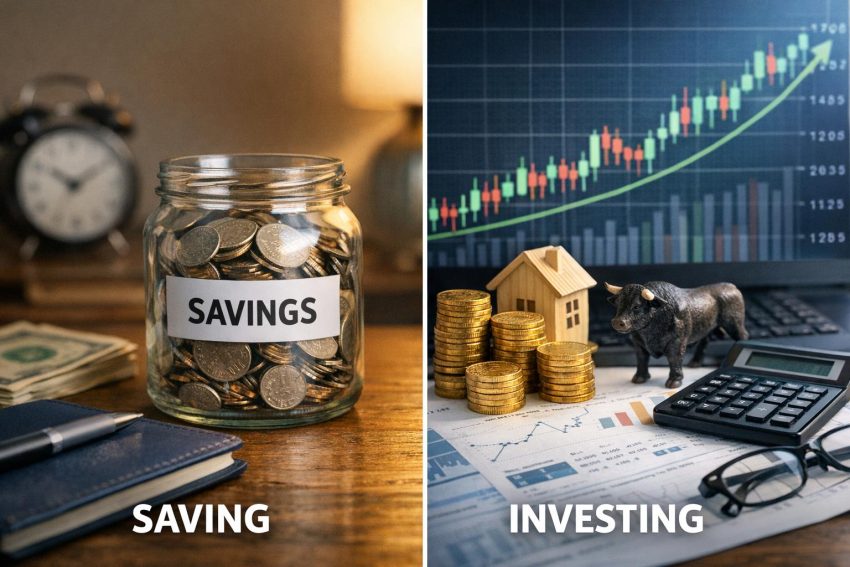
Saving and investing both involve setting money aside, but they perform different jobs. Saving normally means placing cash in an account where its value remains stable and the money can be accessed with little delay. Investing means buying assets that may rise in value or produce income over time, with no guarantee that the original amount will be preserved.
The choice is not simply a matter of which option pays more. It depends on when the money will be needed, how much access is required, the effect of inflation, and how much loss a person could absorb without disrupting their plans. Money reserved for an emergency next month should be treated differently from money intended for retirement in 25 years.
In practice, most people benefit from using both approaches. Savings can cover near-term costs and unexpected bills, while investments may support longer-term goals. The dividing line is not always neat, but the purpose of the money usually points to the more suitable option.
What Is Saving?
Saving is the process of keeping part of current income for later use. The money is generally held as cash in a bank, building society, credit union, or another regulated deposit provider. Common uses include emergency reserves, annual bills, home deposits, education costs, holidays, and purchases planned within the next few years.
Most savings accounts pay interest. Interest is the payment a provider makes for holding a customer’s money. A provider may advertise the rate as an annual percentage rate or annual equivalent rate, depending on local rules. This figure helps customers compare accounts, though compounding frequency, introductory offers, and account conditions can affect the amount received.
A savings rate may be fixed or variable. A fixed rate normally remains unchanged for an agreed term. A variable rate can rise or fall after the account has opened. Central bank policy, competition between deposit providers, and commercial funding needs often influence variable savings rates.
Saving is generally associated with capital stability. If a person deposits £5,000 or $5,000, the account balance does not usually fall because stock markets have had a bad week. The account may also be covered by a deposit protection programme, subject to local eligibility rules and compensation caps.
This stability has a cost. Savings returns are often lower than the long-run returns available from shares and other growth assets. Cash can also lose purchasing power if inflation rises faster than the interest paid. The account statement may show a higher balance, yet that balance may buy less than it did before.
What Is Investing?
Investing involves committing money to an asset with the expectation of future income, capital growth, or both. Common assets include company shares, government bonds, corporate bonds, property, investment funds, exchange-traded funds, and retirement products. Each has its own pattern of risk, cost, access, and expected return.
An investor buying shares acquires ownership in a company. If the business grows, earns more money, or becomes more attractive to buyers, the share price may rise. Some companies distribute part of their profits through dividends. Neither price growth nor dividends are guaranteed, and shareholders may lose their full investment if a company fails.
A bond works differently. The investor lends money to a government or company, which normally agrees to make interest payments and repay the principal on a stated date. Bonds are often viewed as less volatile than shares, but they are not the same as cash. Their prices can fall, and an issuer may miss payments or default.
Investment returns are uncertain because asset prices react to business results, interest rates, inflation, government policy, economic activity, and investor demand. Short-term price movements can be abrupt. A portfolio worth £20,000 at the beginning of a year might be worth less at the end, even if its long-run prospects have not materially changed.
Time plays a major role in investing. Money held for many years has more opportunity to recover after market declines and benefit from compounded returns. A longer holding period reduces the chance that a person must sell during a brief downturn, though it cannot guarantee a profit.
Saving vs Investing at a Glance
| Feature | Saving | Investing |
|---|---|---|
| Primary purpose | Capital preservation and ready access | Long-term growth or income |
| Typical risk | Low, subject to provider and inflation risk | Varies from moderate to high |
| Expected return | Interest set by the account provider | Uncertain capital growth, income, or both |
| Access | Often immediate, though account rules vary | Requires an asset sale; timing and costs vary |
| Common time period | Days to several years | Usually five years or longer |
| Value fluctuations | Account balance is generally stable | Market value can rise or fall |
| Inflation protection | Depends on the interest rate | Possible over long periods, but not guaranteed |
The table gives a broad comparison rather than a rule for every product. A fixed deposit may restrict access more than a publicly traded fund. A short-dated government bond may fluctuate less than a single company share. Product terms always matter.
The Main Differences Between Saving and Investing
Risk to the Original Capital
Savings accounts generally aim to preserve the amount deposited. A customer may know that the account contains the same principal plus any interest due. Eligible deposits may also receive protection through a statutory compensation programme if the provider fails.
Protection arrangements vary by country. They normally apply only to eligible deposits held with authorised institutions and only up to a stated cap. Several brands may operate under one banking licence, which can affect how the cap applies. Cash held above the compensation level may remain exposed if the institution becomes insolvent.
Investments carry a different form of risk. Their market value changes, sometimes daily. Even a regulated broker cannot protect an investor from ordinary market losses. Compensation arrangements may cover certain failures by an authorised firm, but they do not reimburse someone simply because shares, bonds, or funds fell in price.
Risk also varies within each asset class. Shares in a mature business are not identical to shares in a small early-stage company. A bond issued by a financially stable government does not carry the same credit risk as debt issued by a heavily indebted company. Product labels alone do not tell the full story.
Return Potential
Savings returns are normally easier to estimate. If an account pays a fixed annual rate and no withdrawals occur, a customer can calculate the expected interest with reasonable accuracy. Tax, compounding, account fees, and deposit dates may alter the final figure.
Investment returns cannot be known in advance. Shares may produce capital gains and dividends, while bonds may produce interest and price changes. Property may provide rent and a future sale gain, but repairs, vacancies, taxes, legal charges, and management costs reduce the amount retained.
Higher expected returns usually require accepting more uncertainty. That does not mean a risky asset will provide a better result. It means investors often demand the possibility of a higher return before accepting a greater chance of loss. A speculative share can lose most of its value without ever rewarding that risk.
Access and Liquidity
Liquidity describes how quickly an asset can be converted into cash at a reasonable price. An instant-access savings account is highly liquid because money can normally be transferred or withdrawn promptly. Notice accounts and fixed deposits are less liquid because early access may be blocked or penalised.
Listed shares and exchange-traded funds can often be sold during normal market hours. The trade may execute quickly, but settlement can take one or more business days. A sharp price decline may also mean that the seller receives less than expected.
Property is far less liquid. Finding a buyer, arranging surveys, obtaining finance, and completing legal work can take months. Sale costs can also be substantial. Property therefore has little value as an emergency reserve, even if its estimated market price appears stable.
Some retirement accounts restrict withdrawals until a stated age or event. Others permit access but apply taxes or penalties. An asset can be valuable on paper and still be unsuitable for bills due next week.
Time Horizon
A time horizon is the period before money is expected to be spent. A short horizon usually favours cash because there is little time to recover from an investment decline. A longer horizon may make market risk more manageable, particularly if the money is spread across many assets.
There is no universal point at which saving should become investing. Five years is often used as a rough dividing line, but personal circumstances matter. A person planning a house purchase in six years may still prefer cash if the purchase date is fixed and a loss would prevent it. Another person with a flexible ten-year goal may accept more investment risk.
The date is only part of the issue. The consequences of falling short also matter. Money for optional travel can tolerate more uncertainty than money reserved for tuition fees or a tax payment. The less flexible the goal, the stronger the case for stability as the spending date approaches.
Predictability
Savings make budgeting relatively straightforward. The account holder can see the current balance and, with a fixed rate, estimate future interest. There may still be uncertainty if the rate is variable or if tax rules change, but market prices do not usually affect the principal.
Investments provide much less short-term predictability. Long-run return assumptions can help with planning, but they are estimates rather than promises. Actual results may differ widely from historical averages. Returns also arrive unevenly: strong years, flat years, and negative years rarely appear in a tidy sequence.
Common Savings Products
Easy-Access Savings Accounts
Easy-access accounts allow withdrawals with little or no notice. They are commonly used for emergency funds, household buffers, and planned spending. Rates are normally variable, so providers can change them after giving any notice required under local rules.
Some accounts advertise an attractive rate but restrict how often money can be withdrawn. Others include a temporary bonus that disappears after several months. The headline rate deserves attention, but so do withdrawal conditions and the rate paid after any introductory period ends.
Notice Accounts
A notice account requires the customer to request a withdrawal in advance, perhaps 30, 60, or 90 days before receiving the money. The provider may pay a higher rate in return for reduced access. These accounts can suit known future costs, but they are less useful for emergencies.
Some providers allow immediate withdrawals in exchange for lost interest or another penalty. Anyone considering a notice account should check how the penalty is calculated and whether partial withdrawals are permitted.
Fixed-Term Deposits
Fixed-term deposits, also called fixed-rate bonds in some countries, hold cash for an agreed period. Terms may range from a few months to several years. The interest rate is normally fixed at the start, giving the customer a predictable nominal return.
The main trade-off is access. Early withdrawals may be prohibited, allowed only in narrow circumstances, or subject to a charge. A fixed rate can become unattractive if market rates rise after the deposit begins. On the other hand, it may look favourable if market rates fall.
Regular Savings Accounts
Regular saver accounts reward customers for making monthly deposits. They may pay a higher advertised rate, though the amount that can be deposited each month is often capped. Missing a payment or making a withdrawal may result in a lower rate.
The interest can look smaller than expected because the full annual contribution is not present from the first day. Money deposited near the end of the term earns interest only for the remaining months. That is normal arithmetic, not a hidden loss, but it occasionally catches people out.
Tax-Advantaged Cash Accounts
Some jurisdictions allow interest to be earned within an account that receives favourable tax treatment. Contribution caps, withdrawal rules, age conditions, and eligible products differ between countries. A tax advantage can improve the net return, though a poor rate does not automatically become attractive because it sits inside a tax wrapper.
Common Investment Types
Company Shares
A share represents part ownership of a company. Shareholders may benefit from rising profits, expansion, share buybacks, and dividends. They also bear the risk of falling earnings, poor management, competition, debt problems, legal claims, and insolvency.
Holding one or two shares creates concentration risk. Even a well-known company can suffer a lasting decline. Spreading money across many companies, industries, and regions can reduce dependence on one business, though it cannot prevent losses across the broader market.
Government and Corporate Bonds
Bonds generally provide contractual interest payments and the return of principal at maturity, assuming the issuer meets its obligations. Government bonds are backed by the issuing state, while corporate bonds depend on the financial health of the company.
Bond prices and market interest rates tend to move in opposite directions. If new bonds begin paying higher rates, older bonds with lower coupons become less attractive and may fall in price. Bonds with longer maturities are often more sensitive to rate changes.
Credit risk also matters. An issuer with a weaker financial position may offer a higher yield to attract buyers. That yield compensates for higher risk; it is not free money. If the issuer defaults, investors may recover only part of the amount owed.
Mutual Funds and Unit Trusts
Collective investment funds pool money from many investors and buy a basket of assets. A fund may hold shares, bonds, property securities, cash, or a mix. This structure allows an investor to spread money more widely than might be practical through direct purchases.
Some funds follow an index, while others employ a manager who selects holdings. Index funds usually aim to match a market benchmark before fees. Actively managed funds try to outperform a benchmark or meet another stated objective, but higher charges and manager decisions can affect results.
Fund documents normally describe the investment policy, risk level, charges, dealing arrangements, and past performance. Past figures show what occurred during earlier periods; they do not state what will happen next.
Exchange-Traded Funds
Exchange-traded funds, commonly called ETFs, hold a basket of assets and trade on a stock exchange. Many track an index covering shares, bonds, commodities, or another market segment. Their prices change throughout the trading day.
ETFs may offer low annual charges and broad market exposure, but investors should also consider brokerage commissions, bid-offer spreads, currency conversion, tracking difference, and tax treatment. A narrow industry ETF can be far more volatile than a broad market fund, despite using the same ETF structure.
Property
Direct property investment can produce rent and capital gains. It can also bring maintenance bills, vacant periods, insurance costs, taxes, legal work, and tenant management. Borrowing adds interest-rate risk and increases both gains and losses on the owner’s capital.
Property-focused funds provide access without requiring the investor to buy a building. Their prices may still fall, and some funds can suspend withdrawals during periods of heavy selling if the underlying buildings cannot be sold quickly enough.
Inflation and Purchasing Power
Inflation measures how prices change over time. If annual inflation is 4% and a savings account pays 2%, the account balance grows in nominal terms but loses purchasing power. A £10,000 balance becomes £10,200 before tax, yet average prices have risen faster.
The return after inflation is called the real return. A simple approximation subtracts inflation from the nominal return. If an account earns 3% while prices rise by 2%, the approximate real return is 1%. The exact calculation produces a slightly different result because percentages compound.
Cash remains useful even when its real return is negative. Its role may be stability and access rather than growth. An emergency fund does not need to beat the stock market; it needs to be available when the boiler stops working on a cold Monday morning.
For goals several decades away, holding everything in cash can create another risk: the money may fail to keep pace with living costs. Shares and property have historically offered a better chance of outpacing inflation over long periods, but returns vary and losses remain possible.
Emergency Funds Should Usually Remain in Cash
An emergency fund covers unplanned costs or a temporary fall in income. Typical uses include urgent home repairs, medical bills, vehicle repairs, or living costs after redundancy. Since the timing cannot be predicted, access and capital stability normally matter more than return.
There is no single emergency fund amount that suits every household. Several months of core expenses is a common reference point, but the right level depends on job security, household income, insurance, dependants, health, debt payments, and access to other resources.
A household with two stable incomes may choose a smaller reserve than a self-employed worker whose monthly income varies. Someone responsible for an older property or several dependants may prefer more cash. Personal figures beat broad rules here.
The account should be accessible without exposing the money to market movements. A separate savings account can also reduce accidental spending. The rate still matters, though chasing a slightly higher rate should not create delays or withdrawal restrictions that defeat the fund’s purpose.
Matching Money to Short-, Medium-, and Long-Term Goals
Short-Term Goals
Money needed within the next few years generally belongs in savings. Examples include a tax bill, wedding costs, a home deposit, tuition fees, or replacing a car. The spending date may arrive during a market decline, leaving no time to wait for prices to recover.
Fixed deposits may suit goals with a known date, provided the maturity date falls before the payment is due. Easy-access accounts are more appropriate if the amount or timing may change.
Medium-Term Goals
Goals around three to seven years away require more judgement. Cash may suit a fixed, non-negotiable expense. A mix of cash and lower-volatility investments may be considered where the date is flexible and some loss can be accepted.
The allocation may change as the goal approaches. Money can gradually move from market assets into cash, reducing dependence on prices at the point of withdrawal. This process is sometimes called de-risking.
Long-Term Goals
Investing is often considered for retirement, future education costs, or wealth accumulation over ten years or more. The longer period gives returns time to compound and allows more time after market declines.
Long-term does not mean risk can be ignored. The investment mix should reflect the investor’s financial capacity, behaviour during losses, income needs, and withdrawal schedule. A portfolio that causes panic selling is probably carrying more risk than the holder can manage.
Compounding in Savings and Investments
Compounding occurs when returns begin earning returns of their own. In a savings account, interest may be added to the balance and earn further interest. In an investment account, reinvested dividends and gains can buy more assets, which may then produce further returns.
Suppose £10,000 earns 5% a year and all returns are retained. After one year, the value becomes £10,500. In the next year, the 5% return applies to £10,500 rather than the original £10,000. After ten years at a steady 5%, the value would be about £16,289 before tax and fees.
Investment returns do not arrive at a steady rate, so this example is an illustration rather than a forecast. Fees, taxes, withdrawals, and negative years can alter the result. Even so, the principle explains why starting earlier can matter. Time contributes as much as the annual contribution rate in many long-term plans.
How Fees Affect Investment Returns
Savings accounts rarely charge an explicit management fee, although poor rates, withdrawal penalties, and account conditions still have an economic cost. Investments can involve several charges that reduce the amount retained.
A brokerage account may charge dealing commissions, custody fees, platform fees, foreign exchange charges, and transfer fees. Funds deduct annual management and operating expenses. The gap between buying and selling prices, called the bid-offer spread, is another cost.
A one-percentage-point annual fee can appear small, but its effect compounds. If two portfolios earn the same gross return and one costs 0.25% a year while the other costs 1.25%, the difference after 20 or 30 years can be substantial. Cost should not be the only selection factor, but it should never be treated as an afterthought.
Trading frequency also affects costs. Regular buying and selling may produce more commissions, spreads, taxes, and currency charges. It can also turn short-term price movements into taxable gains or realised losses, depending on local rules.
The Role of a Broker
A broker provides access to investments such as shares, bonds, funds, and ETFs. The broker holds assets, processes trades, supplies account records, and may offer research or portfolio tools. It does not guarantee the performance of investments bought through the account.
Before opening a brokerage account, an investor should check the firm’s regulatory status, account protections, fee schedule, available markets, currency charges, order types, and withdrawal process. Compensation arrangements for brokerage accounts often differ from deposit insurance.
Execution quality also matters. A low advertised commission may be offset by wide spreads, poor currency rates, or fees for basic account functions. The cheapest headline price is not always the cheapest account in actual use.
Some brokers offer margin trading, contracts for difference, options, or other leveraged products. Borrowing can magnify both gains and losses. Such products perform a different role from ordinary long-term ownership of shares or funds and require careful risk assessment.
Debt Before Investing
High-interest debt can change the saving-versus-investing decision. Paying off a credit card charging 20% a year produces a predictable reduction in future interest. An investment would need to earn more than that rate after tax and fees to provide a better financial result, and it would have to do so without certainty.
A basic cash reserve can still be useful while debt is being repaid. Without any reserve, the next unexpected bill may go straight back onto the card. One approach is to keep a modest emergency buffer, direct extra money to expensive debt, and build a larger reserve after the balance falls.
Lower-rate borrowing requires a more balanced assessment. Mortgage rates, student loan rules, early repayment charges, tax treatment, and employer retirement contributions can all affect the calculation. Matching contributions from an employer may be valuable enough to merit participation even while some debt remains.
Risk Capacity and Risk Tolerance
Risk capacity is the financial ability to bear a loss. A person with stable income, low fixed expenses, ample cash reserves, and decades before retirement may have greater capacity than someone who will rely on the money next year.
Risk tolerance is the emotional and behavioural ability to live with changing values. Someone may have high financial capacity but still lose sleep after a 10% decline. Another person may feel relaxed about volatility but lack the financial capacity to accept it.
Both measures matter. Taking more risk than a plan can support may force a sale after a decline. Taking more risk than a person can tolerate may lead to repeated strategy changes, often after prices have already moved.
A suitable investment plan should be bearable during ordinary market falls, not just attractive during rising markets. Looking at historical drawdowns can provide context, though future declines may differ in length and severity.
Saving and Investing Can Work Together
The two approaches are complementary. Cash covers near-term needs, while investments support goals that can tolerate price movement. Separating money by purpose helps prevent one goal from undermining another.
A household might keep monthly spending in a current account, hold an emergency reserve in easy-access savings, place next year’s planned costs in a fixed deposit, and invest retirement contributions in broad funds. Each account has a separate job.
A cash reserve can also help an investor avoid selling during a downturn. If the roof needs repair while markets are down, the bill can be paid from savings rather than by selling shares at depressed prices. That practical benefit is easy to miss when people compare returns alone.
Common Saving and Investing Errors
Investing Money Needed Soon
Markets do not follow personal calendars. Money set aside for a near-term deposit, tax payment, or tuition bill may fall just before it is needed. A probable higher return is poor compensation if a loss would cancel the plan.
Keeping Every Long-Term Pound or Dollar in Cash
Cash avoids market volatility but remains exposed to inflation. Over several decades, even moderate inflation can sharply reduce purchasing power. Long-term money may need some exposure to assets with growth potential.
Ignoring Account Conditions
A high savings rate may apply only to a small balance, require monthly deposits, or disappear after an introductory period. Investment platforms may charge inactivity, transfer, custody, or foreign exchange fees. Reading the schedule is dull, but cheaper than finding out later.
Concentrating Money in One Asset
Owning shares in one employer, one industry, or one country creates dependence on a narrow source of return. Direct property owners may face a similar issue if most of their wealth sits in one building. Spreading holdings reduces the damage caused by one poor result.
Chasing Recent Performance
An asset that performed well last year may already carry a high price. Buying after a sharp rise and selling after a fall can produce the opposite of the intended result. A planned allocation and regular contributions often provide a more disciplined basis for decisions.
Confusing Provider Protection With Investment Protection
Regulation and compensation programmes may protect customers against certain forms of provider failure or misconduct. They do not normally cover market losses. A regulated investment can still fall to zero.
Tax Treatment
Interest, dividends, rental income, and capital gains may be taxed differently. Some countries offer personal allowances or tax-advantaged accounts. Others tax returns based on income level, holding period, account type, or residency.
Tax affects the return retained after costs. A savings account paying 4% before tax may produce less for a taxpayer whose interest exceeds the relevant allowance. An investment held inside a recognised retirement or tax-advantaged account may receive different treatment from the same asset held in a standard brokerage account.
Rules can change, and cross-border holdings can be complicated. Current guidance from the relevant tax authority or a qualified adviser is more reliable than assumptions based on earlier tax years.
How to Decide Whether to Save or Invest
Start with the purpose of the money and the likely spending date. Funds needed at short notice usually require capital stability and ready access. Money that can remain untouched for many years may be considered for investment.
Then assess the effect of a loss. If a 20% fall would prevent the goal or force borrowing, market exposure may be inappropriate. If the spending date is flexible and the loss would not affect core living needs, a measured degree of investment risk may be acceptable.
Cash reserves and debt should also be reviewed. An emergency fund provides breathing room, while high-interest debt can consume returns faster than many investments can reasonably produce them.
Product details come next: interest rates, fees, withdrawal terms, tax treatment, deposit protection, investment risk, and broker regulation. Two accounts with similar labels may operate quite differently.
A useful working rule is simple: save for stability and access; invest for long-term growth or income. It is a starting point rather than a rigid formula. Personal circumstances, local products, and the cost of getting the decision wrong should guide the final split.
Final Assessment
Saving preserves cash for emergencies, planned spending, and goals that cannot tolerate a short-term loss. It offers predictable access and relative stability, though inflation may reduce what the money can buy.
Investing accepts price uncertainty in exchange for the possibility of higher long-term returns and income. Shares, bonds, funds, ETFs, and property each carry different risks, costs, and access conditions. No investment return is guaranteed.
Most financial plans use both. Cash handles near-term obligations, and investments address goals far enough away to withstand market movement. Matching each sum of money to its purpose, deadline, and acceptable level of loss provides a more reliable basis for decision-making than choosing whichever account or asset currently advertises the highest return.